
Covariates
Covariates are patient-specific factors that a drug’s PK model uses to individualize its predictions — for example body weight or renal function. Which covariates are relevant depends entirely on the drug’s model, so the list you see is drawn from the drug used in this episode (administrators define this catalog — see Administration → Covariate catalog).
The Covariates tab is split into three sub-tabs by type.
Analytical
Section titled “Analytical”Laboratory values, such as creatinine or albumin.
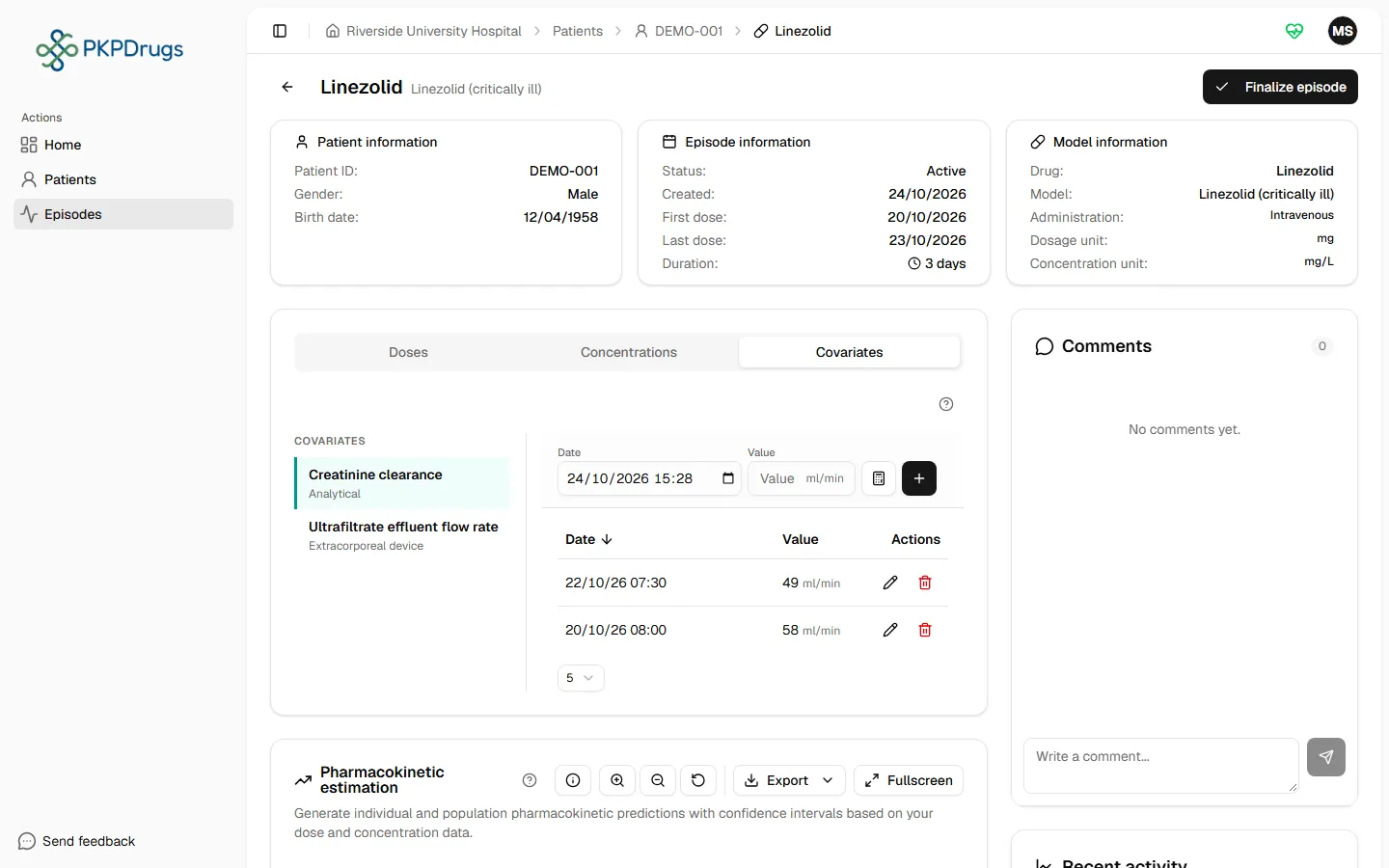
Anthropometric
Section titled “Anthropometric”Body measurements, such as weight or height.
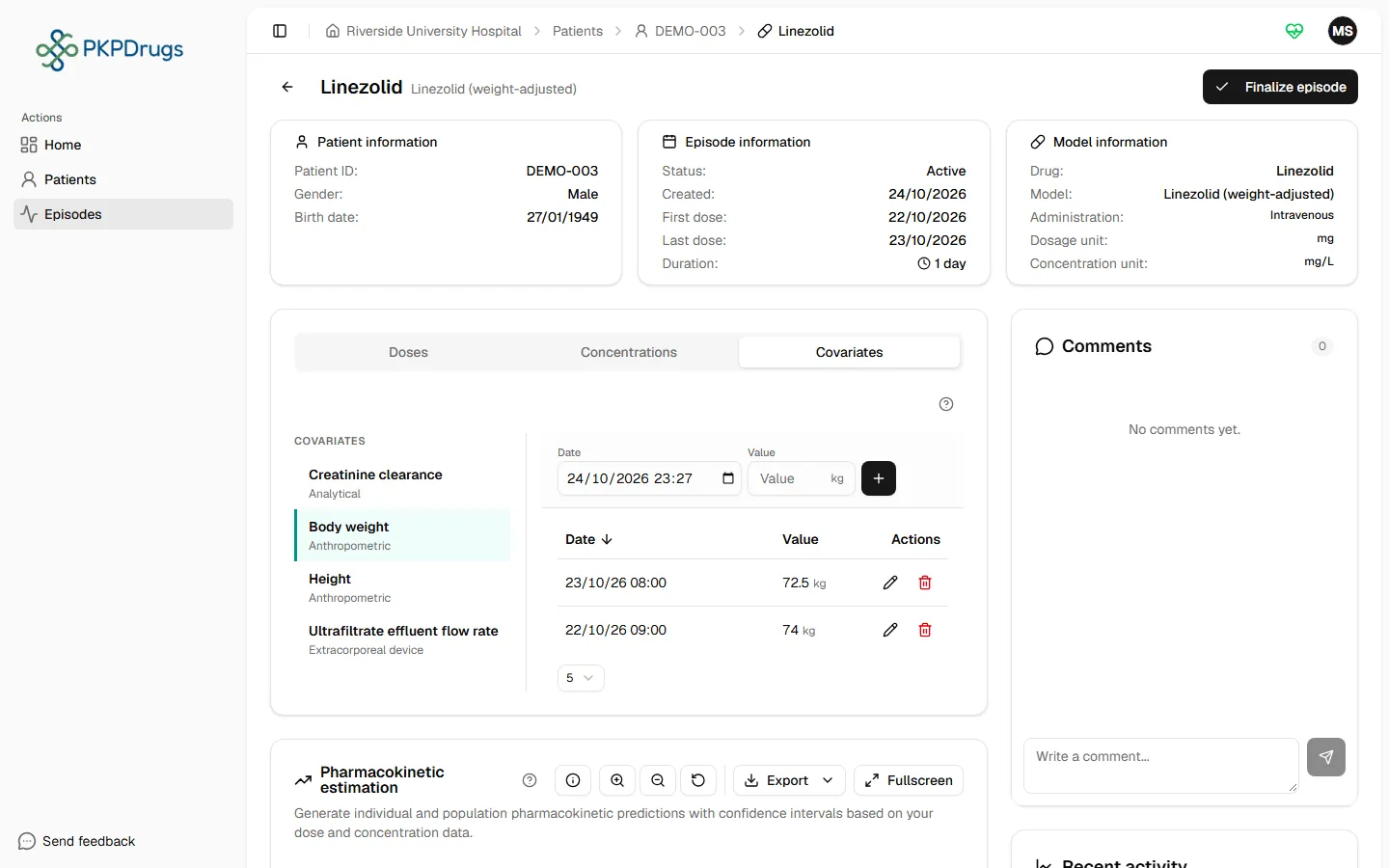
Extracorporeal devices
Section titled “Extracorporeal devices”Devices that affect drug clearance, such as dialysis or ECMO.
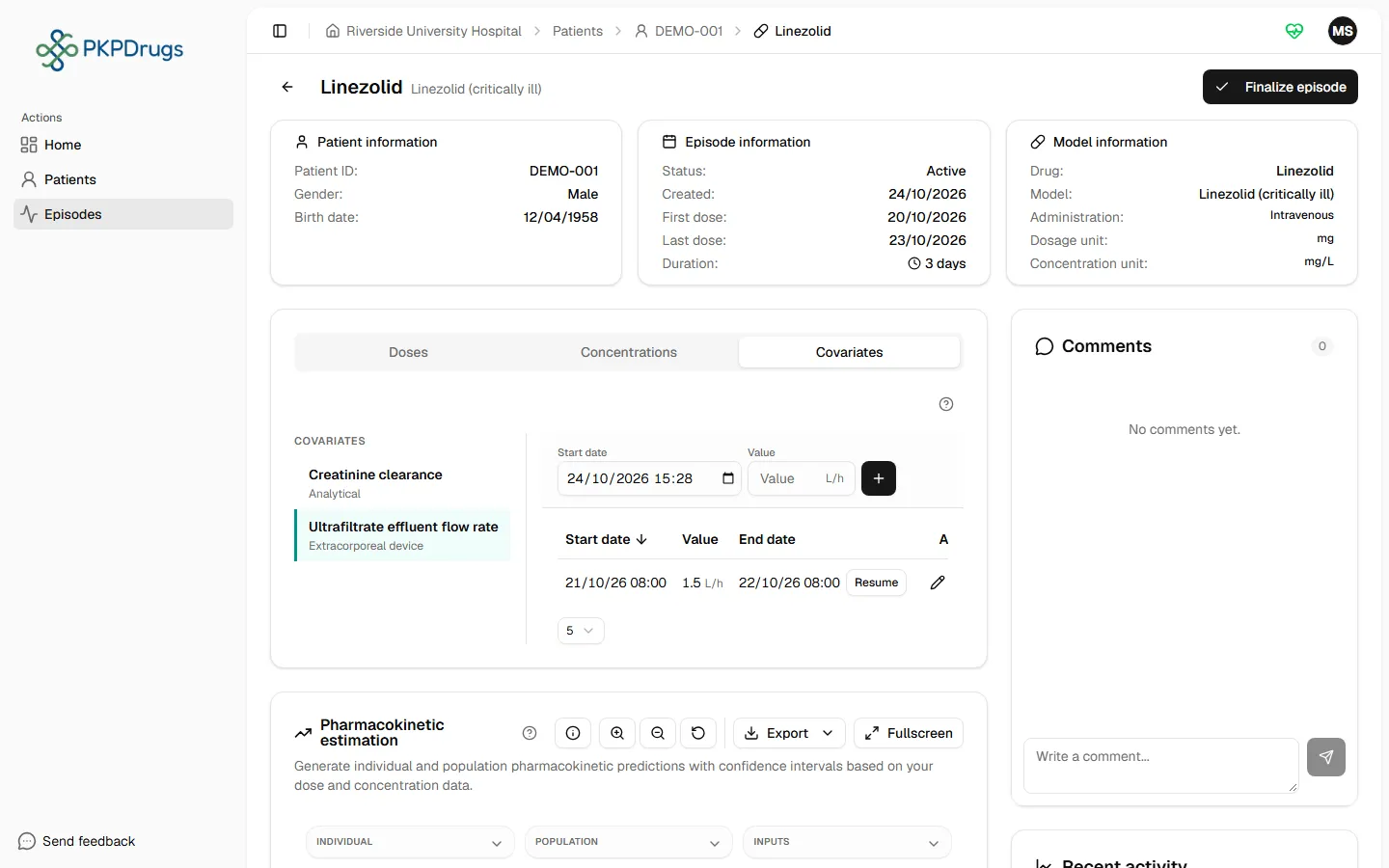
Each entry is time-stamped, and its date cannot be earlier than the first recorded dose.
Possible errors
Section titled “Possible errors”| Message | What it means | What to do |
|---|---|---|
| Date cannot be before the first dose | The covariate’s timestamp is earlier than the episode’s first dose. | Correct the date, or confirm the first dose’s own date/time is right. |
| Value is required | The measurement field was left blank, is not a number, or is negative. | Enter the measured value (0 or more). |
| Date is required | The date and time was left empty. | Enter when the value applied. |
| End date must be after the start date | An extracorporeal session ends at or before its start. | Correct the end, or leave it empty if the session is still running. |
| Weight must be greater than 0 / Height must be greater than 0 / Creatinine must be greater than 0 | One of the fields used to calculate creatinine clearance is zero, negative, or missing. | Enter a real, positive value for every field the calculator shows. |
| Failed to add the record / Failed to update the record / Failed to delete the record | The request reached the server but failed. | Retry; if it persists, check your network connection or contact an administrator. |
Next: Estimation.
Fields, checks and limits
Section titled “Fields, checks and limits”Analytical and anthropometric records
Section titled “Analytical and anthropometric records”| Field | What to enter | Unit | Required | Minimum | Maximum | Message you see if it is wrong |
|---|---|---|---|---|---|---|
| Covariate | Which factor you are recording. You pick it from the list on the left; the record is added to the one selected. | None | Yes | None | None | None |
| Value | The measured value. | The unit set for that covariate in the catalog | Yes | 0 (a negative value is refused) | No upper limit set in the form | Value is required. |
| Date and time | When the value applied. | Date and time | Yes | Not before the first dose | No upper limit set in the form | Date is required. Date cannot be before the first dose. |
If you add a record at the same minute as an existing one for the same covariate, you see a caution (“A record already exists at {date} {time}.”), but you can still save it.
Extracorporeal device records
Section titled “Extracorporeal device records”These records cover a period, such as a dialysis session.
| Field | What to enter | Unit | Required | Minimum | Maximum | Message you see if it is wrong |
|---|---|---|---|---|---|---|
| Start | When the session began. | Date and time | Yes | Not before the first dose | None | Date is required. Date cannot be before the first dose. |
| End | When the session ended. Leave empty if it is still running. | Date and time | No | After the start (the same time is refused) | None | End date must be after the start date. Date cannot be before the first dose. |
| Value | The device setting, if the covariate has one. | The covariate’s unit | See the form | 0 (a negative value is refused) | None | Value is required. |
Two sessions of the same device can touch, but they cannot overlap. If they overlap, PKPDrugs tells you which session is in the way and what end time to use. A session that is still running must be ended before you add a new one that starts during it.
Creatinine clearance calculator
Section titled “Creatinine clearance calculator”Some models need creatinine clearance (CLCR). The calculator offers three equations: Cockroft-Gault (adults), Schwartz (children) and Salazar-Corcoran (overweight patients). Age is taken from the patient’s birth date. You can tick Remember this choice for this patient.
| Field | What to enter | Unit | Required | Minimum | Maximum | Message you see if it is wrong |
|---|---|---|---|---|---|---|
| Weight | Body weight. Not asked for with Schwartz. | kg | Yes, except with Schwartz | Greater than 0 | None | Weight must be greater than 0 |
| Height | Body height. Asked for with Schwartz and Salazar-Corcoran; not asked for with Cockroft-Gault. | cm | Yes, except with Cockroft-Gault | Greater than 0 | None | Height must be greater than 0 |
| Serum creatinine | Lab value. | mg/dL | Yes | Greater than 0 | None | Creatinine must be greater than 0 |
Pharmacogenetic covariates (on the patient page)
Section titled “Pharmacogenetic covariates (on the patient page)”| Field | What to enter | Unit | Required | Minimum | Maximum | Message you see if it is wrong |
|---|---|---|---|---|---|---|
| Covariate | Which genetic factor. | None | Yes | None | None | Please select a covariate |
| Value | The result. | Shown in the Units column | Yes | Greater than 0 | None | Value must be a number greater than 0 |
These values are kept once per patient and are used in every episode of that patient.